Standing at Auschwitz Changed Me
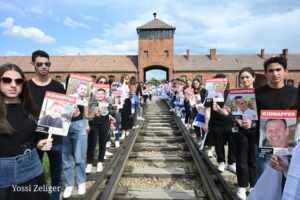
Marching the three kilometers from Auschwitz I to Birkenau reshaped my understanding: the Holocaust was no longer a subject I taught; it was a living inheritance I was responsible for transmitting.
Before my Bat Mitzvah, I remember sitting at my grandparents' kitchen table in Newton, Massachusetts, listening to my grandfather, Sidney Handler, speak about an upcoming trip he was leading with the March of the Living. He described the journey with a gravity reserved for this subject alone: first to Vilna, Poland—his birthplace, now Vilnius, Lithuania—then to Poland, and finally to Israel. Vilna was where his childhood was stolen. Poland was where his father, Hirsch, and older brother, Berel, were murdered at Stutthof. Israel was where his surviving cousin—and the next generations of our family—rebuilt their lives, and where Jewish life continued.
I asked if I could go with him. Gently but firmly, he told me I was not yet prepared for the emotional weight of the March. But then he made me a promise: when I turned eighteen, he would take me to Vilna. And one day, he assured me, I would go on the March of the Living.
My grandfather participated in at least three Marches during his lifetime. He did not return to Europe to dwell in death; he returned to bear witness. For him, the March was about continuity. Over time, it also became something deeply personal between us—a shared language of memory, responsibility, and hope.
On my eighteenth birthday, my phone rang. He and my mother had been secretly planning a trip. We were going to Vilna the following month. He had kept his promise.
Walking beside him through the streets of Vilnius—past Subačiaus Street, where he had been imprisoned in the HKP labor camp; through the remnants of the Vilna Ghetto; and to Ponary, where tens of thousands of Jews were murdered, including my great-great-grandparents and so many aunts, uncles, and cousins—I began to understand what it meant to inherit memory. I was not simply learning history; I was stepping into it.
Still, I held him to his other promise: that one day, I would go on the March.
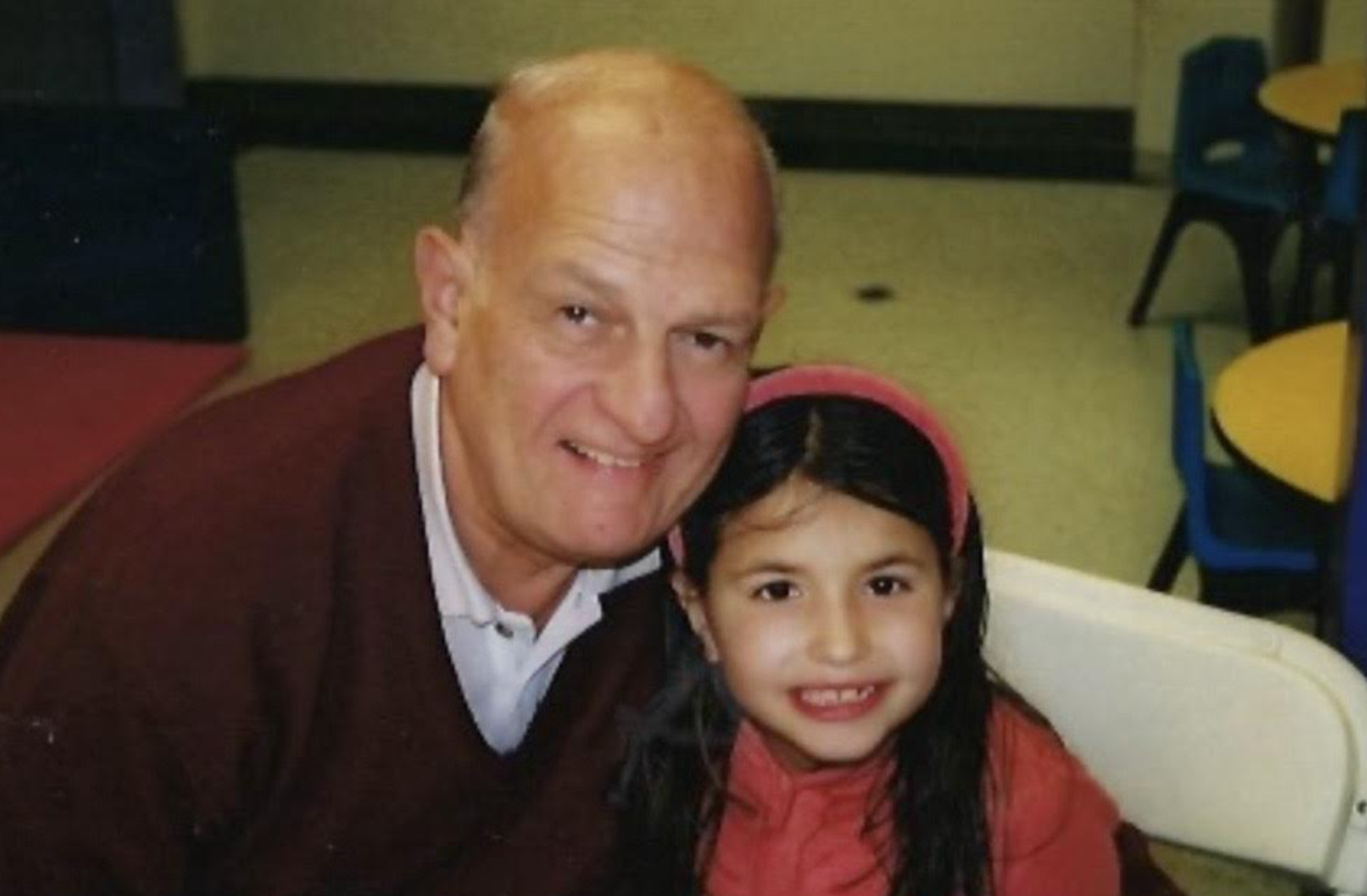
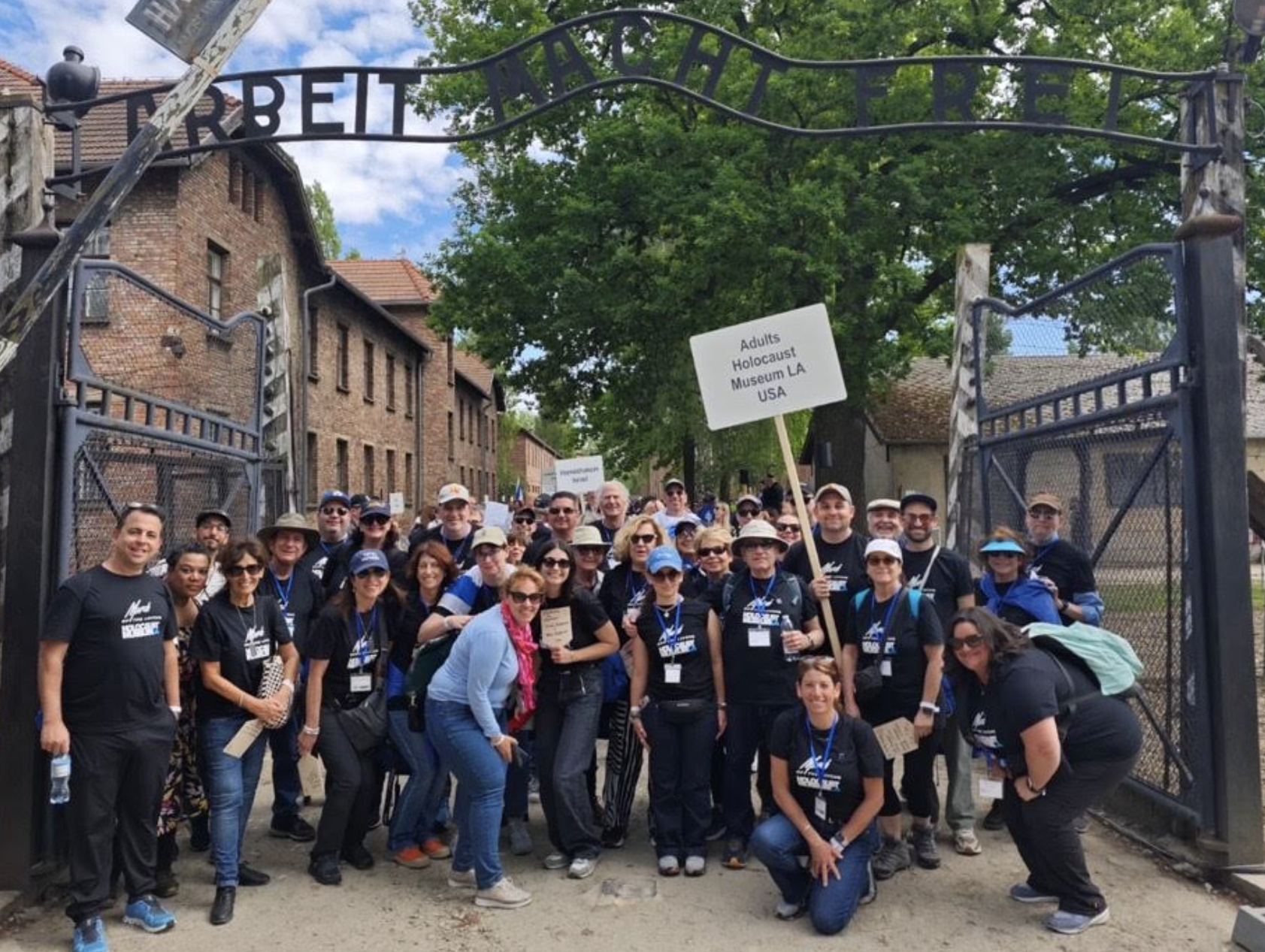
Left: Jessica Handler with her grandfather Sidney Handler; Right: Leading the Holocaust Museum LA delegation at Auschwitz (Courtesy)
Six years later, I earned my Master's degree in Holocaust Studies from the University of Haifa, inspired by my grandfather's lifelong commitment to Holocaust education and remembrance and having developed my own deep passion for this work. I soon landed my dream job at Holocaust Museum LA. In my first year on staff, the museum began partnering with the March of the Living and sending its own delegation. I shared with my supervisor that I had never been—that participating in the March was something I had always hoped to do.
The following year, she told me I would be leading the museum's delegation.
I do not think a Jewish person has ever been so excited to "return" to Poland.
The trip was meaningful in countless ways. What struck me most was the realization that I was walking in my grandfather's footsteps—not as a granddaughter holding his hand, but as an educator entrusted with carrying his story, and the stories of other survivors, forward.
On the day of the March, we were given paddles on which to write the names of those we were marching for. I wrote Hirsch and Berel Rejzewski—my grandfather's father and brother. Their lives were cut short at Stutthof. They have no graves for us to visit. Yet on that day, their names were carried through Auschwitz-Birkenau by their great-granddaughter.
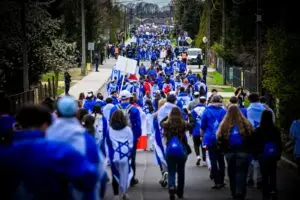
Standing at Auschwitz changed me. I had studied the Holocaust for years. I knew the documents, the historiography, the testimonies. But walking the three kilometers from Auschwitz I to Birkenau, surrounded by thousands of Jews and allies from around the world, reshaped my understanding. The Holocaust was no longer only a subject I taught; it was a living inheritance I was responsible for transmitting.
To stand between memory and the future is to occupy a fragile and sacred space. It is to hold the stories of those who survived and those who were murdered, and to decide—every day—how they will be told. It is to translate trauma into testimony, and testimony into education. It is to ensure that remembrance does not calcify into ritual, but remains urgent and alive.
My grandfather passed away on August 23, 2025. In the months since, I have felt the weight of that in-between space more acutely than ever. The March of the Living has become one of the enduring connectors between us—when he was alive and now after. It is where I feel closest to his voice, to his footsteps, to the promises we made to one another. I am no longer only the granddaughter listening at the kitchen table. I am now part of the generation responsible for safeguarding his memory.
The March of the Living is often described as a bridge—from Auschwitz to Birkenau, from destruction to rebirth, from exile to Israel. But I have come to understand it as something even more personal. It is the bridge between my grandfather's voice and my own. Between his childhood in Vilna and the classrooms where I now teach in Los Angeles. Between the names of Hirsch and Berel and the students who now carry their memory forward.
To stand between memory and the future is not a passive act. It demands courage—the courage to return to places of devastation, the courage to teach in a world where antisemitism persists, the courage to affirm that Jewish life not only survived but continues.
When my grandfather promised that I would go on the March one day, he was not simply making travel plans. He was entrusting me with a responsibility.
I have walked the path from Auschwitz to Birkenau. I have stood in Vilna where he once stood. And now, in my work and in my life, I carry forward what he carried before me.
Memory is not the opposite of the future. It is its foundation.