How the March of the Living Transformed My Identity and Purpose
Jonathan Thull
2003 March of the Living alumnus
I grew up in Winston-Salem, North Carolina, a small Southern city where Jewish life was quiet and sparse. In my religious school class there were only six of us. Judaism existed in a small room once a week, in holiday rituals at home, and accompanying stories handed down through generations. It felt important, but distant — something inherited rather than fully lived.
I knew about the Holocaust the way many students do: through textbooks, documentaries, and solemn remembrance days. I understood it intellectually, but it remained abstract, almost unimaginable.
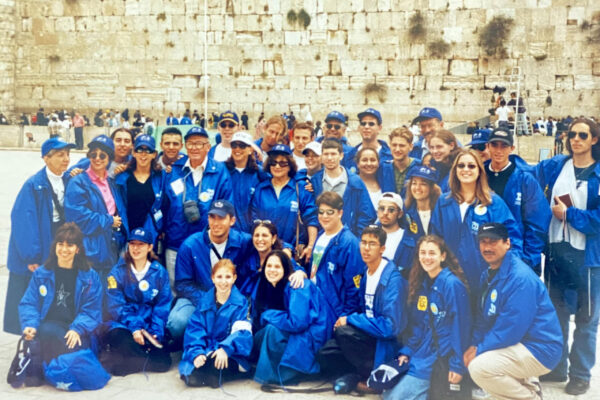
On the March of the Living I was no longer one of a handful of Jewish kids in a Southern town. I was immersed in a sea of Jewish peers from around the world — so many of us carrying the same ancient history. For the first time in my life, Jewishness was not a minority identity. We were all Jewish.
Yet we were gathered not for celebration, but to confront the darkest chapter of our people’s story. That contrast — vibrant Jewish youth standing in places built for our annihilation — was overwhelming and transformative.
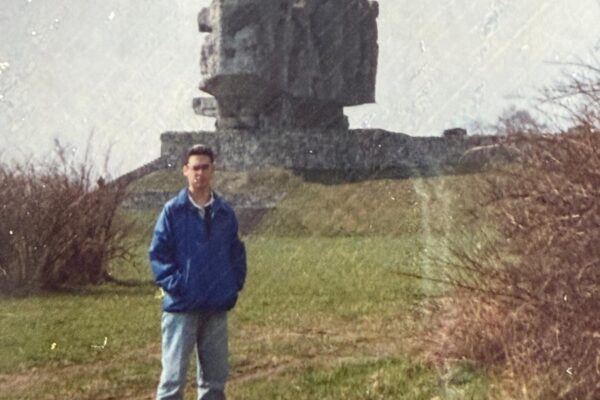
Nothing prepared me for what it meant to stand in the camps themselves. You can read every book, watch every film, memorize every statistic, and still be unprepared. What struck me most was not just what I saw, but what I physically experienced. At one point, walking through the camp in the freezing cold, snow covering everything, I suddenly became overwhelmed.
My body reacted in a way I could not explain. I was sweating — drenched in heat — despite the winter air. A friend beside me was shivering, so I took off my coat and gave it to them. I continued walking in short sleeves, still burning, as we passed through the very chambers that murdered my brethren. It felt as if my body was processing something my mind could not yet grasp.
By another barrack in a memorial, we saw piles of ash and bone. Not symbolic remains — actual human remains. The smell of death lingered in the air. It was unmistakable, physical, undeniable. History stopped being history. It became present reality beneath my feet and in my lungs. In a world where some deny or distort the Holocaust, there was no room for doubt there.
The evidence was not in books. It was in the ground, in the air, in the silence. Yet alongside the horror, something else was happening inside me. For much of my life, I had been on a quiet quest for Jewish love — for a sense of Jewish-ness and belonging that I had rarely felt growing up in such a small community. On the trip, I witnessed the manifestation of that love in the most unexpected way. My cousin met the woman who would become his wife during our journey through Poland and later Israel. Watching their connection form in the shadow of tragedy felt like a defiant affirmation of life. Even in places designed for death, Jewish continuity was unfolding in real time.
As difficult as many of the days were, the evenings were something entirely different. After confronting the darkness, we gathered together — arms around one another, singing, dancing, laughing, crying. We celebrated life as Jewish youth. Those moments were not frivolous; they were essential. They were proof that the Nazis did not win. The contrast between the shows of death by day and the explosion of life by night created a kind of emotional whiplash, but also a profound clarity: being Jewish is not only about remembering how we died, but about how we live.
That realization transformed my identity. Judaism was no longer just a religion I practiced occasionally. It was a people I belonged to — a global family bound by history, resilience, humor, memory, and hope. The experience awakened a deep sense of connection and responsibility within me.
In the years that followed, that connection only deepened. I returned to Israel nine times, eventually becoming an Israeli citizen and spending nearly six years there across those journeys. Before the March, Israel had been an idea — a distant homeland spoken of in prayers and news headlines. During the march Israel became our refuge and an oasis of milk and honey.
After the March, it felt essential. Standing in the shadow of genocide made the existence of a Jewish state feel not political, but existential — a living answer to the question of survival.
The March also changed how I see injustice in the world. Once you witness the consequences of hatred taken to its extreme, it becomes impossible to ignore suffering anywhere. The Holocaust did not begin with gas chambers; it began with words, stereotypes, exclusion, and indifference. That lesson echoes loudly in our world today.
In memory of my father, I later helped raise over $25,000 at a small community college to support Holocaust education, including a collection, a course, and ongoing social justice initiatives. This work felt like a continuation of the responsibility I first felt in Poland — to ensure memory leads to action, not paralysis.
This brings me to the question of what it means to stand between memory and the future. The past must be remembered, but it cannot become a weight that immobilizes us. Memory should be a compass, not an anchor. If we live only in mourning, tragedy defines us. If we forget, we risk repetition. The task of my generation is to carry memory forward in a way that fuels life.
The March of the Living did not give me simple answers. Instead, it gave me a deeper awareness of both humanity’s capacity for evil and its capacity for resilience and love. It connected me to my people, my history, and my purpose.
I left Poland with a realization that has stayed with me ever since: the story does not end in the camps. It continues in the lives we build afterward. Every act of kindness, every effort toward justice, every Jewish wedding, every child born, every song sung is a quiet victory over those who tried to erase us.
To MARCH is to walk through the valley of death. To keep marching afterward — in our communities, our identities, and our choices — is to choose life.
In that sense, the March of the Living is not a single event.
It is a lifelong journey.
And I am still walking.