According to historians Richard Menkis and Harold Troper:
“The Olympic Charter proclaimed the power of athletic and sporting competition as a tool for the promotion of peace and unity between people and nations.
Fundamental to this Olympic vision of peace and harmony through sporting excellence was the expectation that the Olympic Games must take place in an atmosphere of mutual respect and without the burden of political, religious, or racial prejudice.”
The 1936 Nazi Olympics, which what the 1936 Berlin Olympics essentially constituted, were hijacked by Hitler and his propagandists, violating virtually every aspect of the high-minded Olympic ideals referred to above.
Nazi Germany’s racial ideology proclaimed the Germans as the “Master Race”, and the Berlin Olympics were the ideal venue within which their physical supremacy could be showcased.
Equally important, Nazi Germany hoped to burnish its reputation among the nations of the world, by games in the history of the event. Thus, for a period, Nazi officials ordered most examples of persecution against the Jews and other minorities to be hidden until after the games were completed.
Finally, a successful Olympic event would further cement Hitler’s rule and popularity among the local German population.
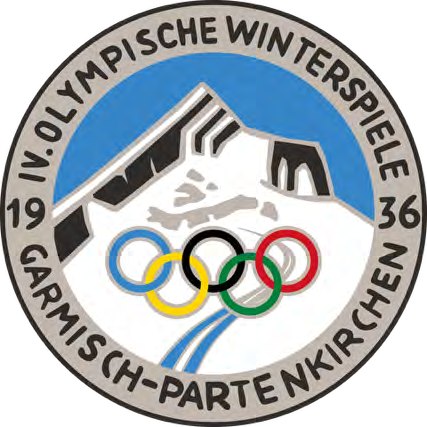
Note: In 1936 both the Olympic Winter and Summer Games were held in Germany - both were used by Nazi Germany for propaganda purposes. The Olympic Winter Games took place in Garmisch-Partenkirchen from February 6–16, with 672 athletes from 28 nations competing. The Olympic Summer Games were held in Berlin from August 1–16, with 3963 athletes from 49 nations competing. Unless otherwise indicated, the Olympics being referred to in this document are the Summer Olympics in Berlin.
IIThe Nuremberg Laws and the 1936 Olympic Games
In 1935, the Nazis passed the infamous Nuremberg Laws, which essentially made German Jews non-persons and removed German Jews from German society. (Article 4/1 of the Order proclaimed, “A Jew cannot be a citizen of the Reich. He cannot exercise the right to vote; he cannot hold public office.”) Jews were subject to the full weight of the law but were afforded no protection of the law. “Their social death was complete”, in the words of the above-mentioned historians.
The 1935 Nuremberg Laws initially mentioned only Jews. The laws were eventually expanded to include Black people and Roma and Sinti (Gypsies) living in Germany, who were also now labelled as racial aliens and denied a place in society.
Yet, in anticipation of the world’s eyes being turned on Germany during the 1936 Olympics, Hitler and his henchmen delayed the full implementation of the Nuremberg Laws until after the Olympics were completed. This allowed Nazi Germany’s propaganda efforts during the Olympics to succeed in fooling the world to the point where the New York Times opined – after the conclusion of the games - that the 1936 Olympics put Germans "back in the fold of nations," and even made them "more human again."
When the summer games were over, Germany exalted in its victory, with 89 German medals vs. 56 for the US. Then Nazi Germany soon followed suit with its ever-increasing persecution of Jews and other minorities and its pursuit of his military goals.
German Jewish diarist Victor Klemperer warned that as soon as the games concluded, the Nazis would “first of all take things out on the Jews.” As the local SA sang, “Wann die Olympiade ist vorbei, / schlagen wir die Juden zu Brei.” (When the Olympics are over, we’ll beat the Jews to a pulp.)
Just a few short years later, the world would learn the full extent of Nazi Germany’s deception and the true intention of their evil designs.
IIIThe 1936 Nazi Olympics: A Case Study in Antisemitism, Racism, Indifference, Ambition & Cowardice
Soon after Hitler took power, Nazi Germany began to prohibit Jews from almost all aspects of civic life, including participating in sports. Jews were excluded from German sport and recreational facilities and German sports clubs.
As early as April 1933, the German Swimming Association banned Jews from its member clubs. The German Boxing Federation forbade Jews to fight in or officiate over German championship contests. Jews people were excluded from hiking and other outdoor activities organized by German Alpine clubs and banned from public swimming pools.
An editorial in the popular and viciously antisemitic Der Stürmer stated: “We need waste no words here. Jews are Jews, and there is no place for them in German sport. Germany is the Fatherland of Germans and not Jews, and the Germans have the right to do what they want in their own country.”
Despite pledging that racism would not occur, the Nazis excluded Jews, Roma and Sinti, who were successful German athletes in the 1930s, from the 1936 Olympics. Examples include:
Erich Seelig, Boxer, expelled from the German Boxing Association.
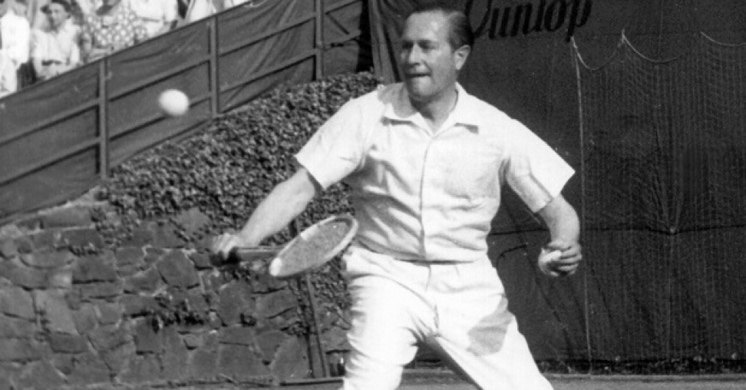
Daniel Prenn, Tennis, was removed from Germany’s Davis Cup Team and banned from international competition.
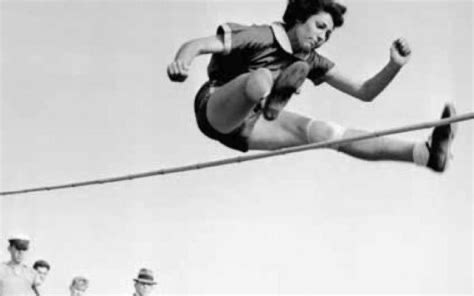
Gretel Bergmann, High Jump, was expelled from her German Club in 1933 and from the National Team in 1936.
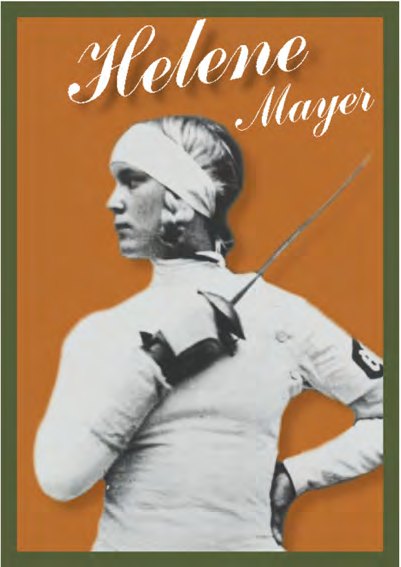
Left to right: Gretel Bergmann, high jumper removed from the 1936 Olympic team days before the Games; Daniel Prenn, Germany’s top tennis player excluded by the Nazis (Yad Vashem / Bundesarchiv).Helene Mayer, USHMM
Nazi Germany did allow two half Jews (Mischlinge) whose fathers were Jewish (but not their mothers) to represent Germany at the 1936 Olympics: Helene Mayer who won a silver medal at the 1936 Summer Olympics, and Rudi Ball, a German ice hockey player who played in the 1936 Winter Olympics. Mayer, who did not consider herself Jewish, and Ball, who played according to some accounts to protect his family in Germany, were the only two exceptions.
Of course, Nazi Germany used their participation as window dressing to cover up their overall policy of excluding German Jews from participation in the 1936 Olympics.
German author Oliver Hilmes: “Berlin 1936: sixteen days in August”
“The strategy of the token Jew was developed by the Americans, and not by the Nazis. The question the international community kept asking at this time was, how would Nazi Germany treat Jewish sportsmen and Jewish people?
“And so, the American sports officials developed the idea that Germany should take one or two Jewish sports people in their Olympic team. And that would be enough to convince the Americans to come to Berlin.”
“Hitler’s sports officials said, okay we take one token Jew, and that was the price Germany had to pay for the US to come to Berlin. And so, the US came to Berlin, and Hitler had his victory.”
Up until the start of the 1936 winter and summer Olympics in Germany, international movements arose to boycott Nazi Germany’s Olympics because of their antisemitic and racist policies. Groups in the United States, Canada, Great Britain, France, Sweden, Czechoslovakia, and the Netherlands lobbied their countries to boycott the 1936 Berlin Olympics.
None of them succeeded.
Among the reasons for their failure were:
Local antisemitism (Avery Brundage, president of the International Olympic Committee (IOC)) was infamous for holding racist, sexist, and anti-Semitic beliefs.
Personal ambition and greed.
Naïve belief that the Nazi-sponsored games would further human relations between competing countries.
Trusting Nazi Germany’s declarations that the games would be free from any taint of racial discrimination.
Contending that sports must be separate from political considerations.
VThe 1936 Winter Olympics in Garmisch-Partenkirchen, Bavaria: A Prelude to the 1936 “Nazi” Summer Olympics in Berlin
The 1936 German Winter Olympics began on Feb. 6, 1936, in the alpine town of Garmisch-Partenkirchen, Bavaria, in southern Germany. Not far away was Dachau, the infamous concentration camp founded in March 1933, and regarded as the first and longest-running Nazi concentration camp.
Dachau was initially used to imprison political opponents. Later prisoners included homosexuals, Roma and Sinti, Jehovah’s Witnesses, and, of course, German Jews.
According to Berlin-based journalist Paul Hockenos, the 1936 winter Olympics were a “spectacle… meticulously orchestrated by the Nazis to showcase Germany’s ostensible civility—in other words, to mask its nefarious intentions—as well as to test-run for the Summer Games.”
Support for Germany to host both the winter and summer games came from the American Olympic Committee president, Avery Brundage, who resisted calls to boycott the German Olympics over its treatment of German Jews. After witnessing overt antisemitism on his visit to Germany in 1934 – including signs saying, “Don’t buy from Jews,” “The Jews are our misfortune,” and “No Jews allowed” - Brundage countered: “In my club in Chicago, Jews are not permitted either.” In part because of Brundage’s stubborn (and false) insistence that Jews were not discriminated against in German sport or Germany, the US Amateur Athletic Union (AAU), eventually voted in 1935—58 to 56—to participate in the games.
Thus, on Feb. 6, 1936, Hockenos writes: “With pomp and marching bands, the 10-day Olympics commenced at the new ski stadium when Hitler, in a long, black leather coat and surrounded by the IOC brass and Nazi higher-ups, opened the Games that morning….The winter events spanned figure skating, speed skating, men’s hockey, bobsled, cross-country skiing, and, for the first time, downhill skiing. The 646 athletes from 28 countries, including Japan, Turkey, and Yugoslavia, made it the largest Winter Games ever at that time.”
“The 1936 Winter Olympics counted as a slam dunk for Hitler: The international extravaganza played straight into his wheelhouse, postponing the day that the world would condemn the regime.”
“On the day of the closing ceremony, propaganda minister Joseph Goebbels wrote in his diary: “Everyone is praising our organization. It was also dazzling. A wonderful picture at the end. Framed by the eternal mountains. Then the fire goes out. The Winter Games are over.”
Like what happened before the summer Olympics in Berlin that were to follow, in Garmisch, all antisemitic signage was scrubbed before the hundreds of thousands of sports fans began visiting the town in February 1936. And like the summer Olympics, virtually all German Jewish athletes were banned from both games (with two notable exceptions: hockey player Rudi Ball and fencer Helene Mayer, both half Jews who the Nazis used in a tokenistic and propagandistic fashion, to cover up their overall ban on German Jewish participation in sports. In fact, by 1935, Germany had banned all Jewish athletes from its sporting leagues.)
Immediately after the Games in Garmisch and Berlin, the Nazis dropped their façade and only intensified their persecution of Jews across Germany on their path to implementing the Final Solution. Both the winter and summer games of 1936 were critical historical points in this journey of deception that ultimately made the world’s greatest athletes complicit in what was to be one of the world’s greatest crimes.
VIWorldwide Jewish and Black Participation at the 1936 Summer Olympics
Some athletes decided to boycott the games for moral reasons. Jeremiah Mahoney, leader of the Amateur Athletic Union in the US, stated that American participation in the Berlin Games meant "giving American moral and financial support to the Nazi regime, which is opposed to all that Americans hold dearest."
According to Menkis and Troper, Canadian Jewish boxers Sammy Luftspring and Norman “Baby” Yack’s expressed their disappointment at not being able to represent Canada but stated that they “have gone into the question very carefully with our families and friends in the community” and knew in good conscience they could not act differently…., “the German Government is treating our brothers and sisters worse than dogs … We would have been very low to hurt the feelings of our fellow Jews by going to a land that would exterminate them if it could.”
Yet a fair number of black and Jewish athletes from countries outside of Germany did participate in the Olympics. Many succeeded in winning a medal, which some viewed as a victory over the Nazis.
But the games themselves were not without racial controversies:
Athletes from several countries gave Adolf Hitler the Nazi salute as they marched into the stadium in Berlin, although they later claimed they thought they were giving the Olympic salute.
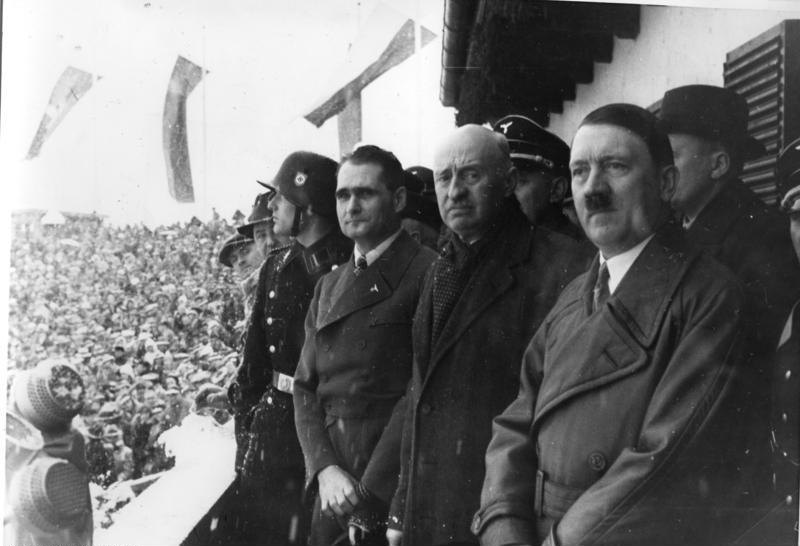
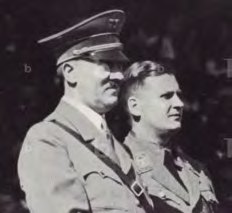
Hitler and Baldur von Schirach together at a Youth rally at the 1936 Nuremberg Party Congress. Bundesarchiv.Nazi youth leader Baldur von Schirach quoted Hitler as saying: “The Americans should have been ashamed of themselves for allowing their medals to be won by Negroes. I would never have shaken this Negro’s [Owens’s] hand.” When he suggested that Hitler be photographed with Owens, Hitler yelled back: “Do you really think I’d allow myself to be photographed, shaking the hands of a Negro??”
American Jewish runners Marty Glickman and Sam Stoller were, at the last minute, replaced by black athletes Jesse Owens and Ralph Metcalfe in the 400-meter relay. Many saw this change as a concession to Nazi anti-Semitism.
Nazi minister Albert Speer wrote that Hitler "was highly annoyed by the series of triumphs by the marvelous colored American runner, Jesse Owens. People whose antecedents came from the jungle were primitive, Hitler said with a shrug; their physiques were stronger than those of civilized whites and hence should be excluded from future games."
Irving "Toots" Meretsky was the only Jewish member of the Canadian Olympic basketball team. He ventured into Jewish neighborhoods in Berlin to deliver letters from Canadian Jewish families to their relatives in Berlin. He later wrote, "No one was on the streets, and the shades were drawn. I knocked at a few doors and was finally let in. It was obvious they were all scared.”
According to historians Menkis and Troper Jewish achievements in sport were antithetical to Nazi ideology. According to Nazi doctrine, they wrote:
“…. Jews prospered not through animal strength but through unbridled satanic cunning. Negating previous Jewish achievements in sport and athletics, Jews were commonly caricatured by the Nazi propaganda machine as physically weak and repulsive bogeymen – short, fat, beady-eyed, round-shouldered, and hook-nosed. They were hardly fit competition for the fraternity of strong white Olympic combatants. As a result, if Black athletic success validated Nazi racial theory, any comparable Jewish success served to undermine it.” 1
1 George Eisen, “Jews and Sport: A Century Retrospective,” Journal of Sport History 26 (1999), 225–39, quoted in More than Just Games: Canada & the 1936 Olympics, Richard Menkis & Harold Troper, University of Toronto Press, 2015
VIIConclusion
Sports, at its finest, should provide the ultimate level playing field for all. All members of the human family should be judged by only one criterion – their ability to perform a given athletic challenge. When living up to this ideal, sports can become a vehicle through which all of humanity can celebrate each other’s achievements. But the 1936 Nazi Olympics were a demonstration of the exact opposite value system.
Both the 1936 Winter and Summer Olympics in Germany offered the world an opportunity to take a moral stance against Germany’s hate-filled policies against Jews and other minorities.
By boycotting the Olympics, the world could have upheld the Olympic ideals of equality, peace and mutual respect, which are the right of every human being on this planet.
Instead, fooled by Germany's deceptions or blinded by ambition and greed, the world caved and allowed Nazi Germany to stage the 1936 Olympics, affording it a platform for its propaganda while camouflaging its true intentions.
As the United States Holocaust Museum concludes: “Despite the exclusionary principles of the 1936 Games, countries around the world still agreed to participate…The Nazis promoted an image of a new, strong, and united Germany while masking the regime’s targeting of Jews and Roma, as well as Germany’s growing militarism. The many nations that sent teams to the 1936 Olympics legitimized the Adolf Hitler regime both in the eyes of the world and of the German domestic audience.”
Within a few years, Germany would launch the world into World War II, resulting in the deaths of tens of millions of innocent people, including 6 million Jews.
The 1936 Olympic Games in Germany were one of many avoidable stepping stones along the way that facilitated this disastrous outcome.
Has the world learned anything since?
MARCH OF THE LIVINGThe 1936 Nazi Olympics and the March of the Living
The goals of the March of the Living include the following:
To never again allow for the unchecked rise of the menace of antisemitism or any kind of discrimination directed by any individual or group against another to gain strength
To teach the world that all human beings deserve equal dignity and respect
To inspire participants to commit to building a world free of oppression and intolerance, a world of freedom, democracy and justice, for all members of the human family
The 1936 Nazi Olympics violated virtually all of the above tenets.
In 2026, March of the Living shed light on the ominous legacy of the 1936 Nazi Olympics and contrast it to the values we are trying to teach our young March of the Living participants.
To this end, we are highlighting the following themes:
The importance of standing up against any form of antisemitism, racism or intolerance. Too many individuals and organizations in the 1930s turned a blind eye to the practises of Nazi Germany leading up to the 1936 Olympic Olympics.
Honoring the brave actions of those individuals – both Jewish and non-Jewish – who did take a courageous stand against participating in the 1936 Olympics.
Remembering the achievements of Jews in sports pre, during and the post Holocaust era.
Paying tribute to the 12 murdered individuals (11 Israelis in the Israeli Olympic delegation and one German policeman) whose lives were taken by terrorists during the 1972 Munich Olympics.
VIIIIOC under fire for selling Nazi-era Olympic Games T-shirt (CNN Article - Feb 13, 2026)
CNN · February 13, 2026
IOC under fire for selling Nazi-era Olympic Games T-shirt
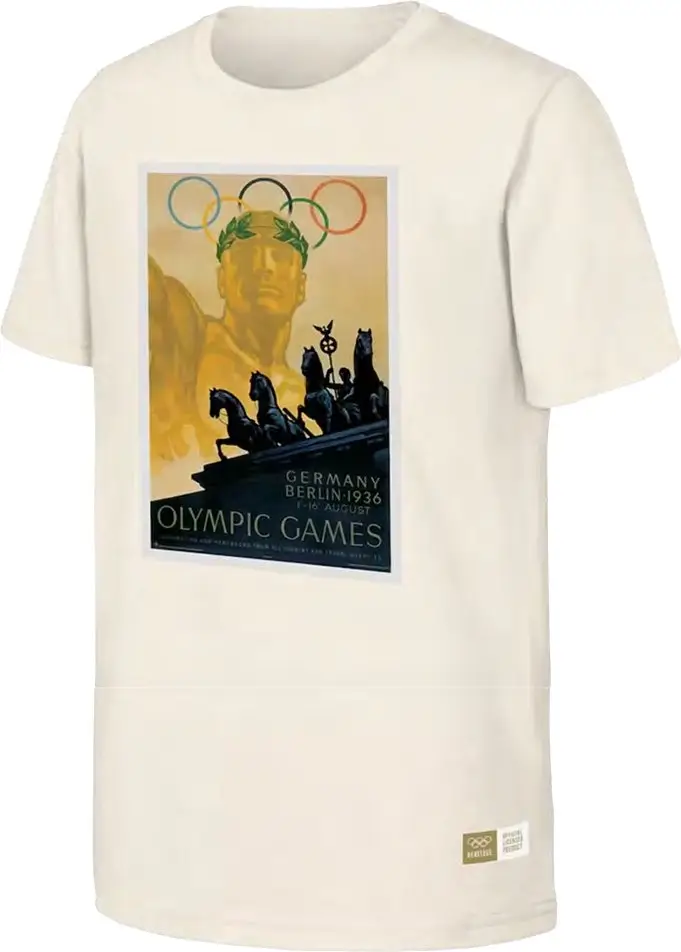
The International Olympic Committee (IOC) has been criticized for selling merchandise commemorating the 1936 Berlin games, which Adolf Hitler used to showcase his Nazi ideology.
The website for the Olympics — currently in the spotlight due to the ongoing Milan Cortina Winter Olympics — features a men’s T-shirt marking the controversial Nazi games. The garment, which is showing as “out of stock,” is part of the IOC’s “Heritage Collection.”
The T-shirt features the original poster for the 1936 games, designed by Franz Würbel. It depicts an athletic male figure crowned with a laurel wreath and with the Olympic rings in the background. The Brandenburg Gate sits beneath him, with the caption: “Germany Berlin 1936 Olympic Games.”
The landing page for the Heritage Collection on the Olympics website states: “Each edition of the Games reflects a unique time and place in history when the world came together to celebrate humanity.”
Hitler used the games, held three and a half years after the Nazis came to power, as a spectacle of Nazi propaganda. He set out to showcase the racial superiority of so-called Aryan athletes and openly denigrated African-American participants as “non-humans.”
Nevertheless, African American athlete Jesse Owens emerged as the star of the games, taking to the podium to collect four gold medals, surrounded by people giving the Nazi salute.
Christine Schmidt is the co-director of the Wiener Holocaust Library in London, the world’s oldest archive of Holocaust materials.
She told CNN: “The Nazis used the 1936 Olympics to showcase their oppressive regime to the world, aiming to smooth over international relations while at the same time preventing almost all German-Jewish athletes from competing, rounding up the 800 Roma who lived in Berlin, and concealing signs of virulent antisemitic violence and propaganda from the world’s visitors.
“The Nazis’ fascist and antisemitic propaganda infiltrated their promotion of the games, and many international Jewish athletes chose not to compete. The IOC would be minded to consider whether any aesthetic appreciation of these games can be comfortably separated from the horror that followed.”
The decision to sell the T-shirt was also criticised by Scott Saunders, CEO of International March of the Living, an annual educational program that will this year see around 8,000 people gathered at the former Auschwitz death camp to commemorate the Holocaust.
He told CNN: “As the world reflects on this latest controversy, it is impossible not to recall that we are approaching 90 years since the 1936 Berlin Olympics — an event the Nazi regime used to legitimize itself on the global stage while persecution of Jews was already well underway.
“Sport has the power to unite, to inspire, and to elevate the very best of humanity. But history reminds us that it can also be manipulated to sanitize hatred and normalize exclusion. The lesson of Berlin is urgent. When antisemitism resurfaces in public life, whether in stadiums, streets, or online, silence is not neutrality. It is complicity.”
The IOC defended its decision to produce and sell the T-shirt. In a statement sent to CNN, an IOC spokesperson said the Olympic Heritage Collection “celebrates 130 years of Olympic art and design” and features all previous games.
The spokesperson added: “While we of course acknowledge the historical issues of ‘Nazi propaganda’ related to the Berlin 1936 Olympic Games, we must also remember that the Games in Berlin saw 4,483 athletes from 49 countries compete in 149 medal events. Many of them stunned the world with their athletic achievements, including Jesse Owens.
“The historical context of these Games is further explained at the Olympic Museum in Lausanne. For the 1936 edition, the number of T-shirts produced and sold by the IOC is limited, which is why they are currently sold out.”
The International Olympic Committee awards the 1936 Summer Olympics to Berlin.
1933
January 30
Adolf Hitler is appointed Chancellor of Germany by President von Hindenburg.
March
The city of Cologne prohibits Jews from using city playgrounds and sports facilities.
March 22
Dachau, the first concentration camp, opens. Political opponents of the Nazi’s are detained.
April 1
The first state-directed boycott of Jewish shops and businesses.
April 4
The German Boxing Federation excludes Jewish boxers from participating in competitive bouts and orders the cancellation of all contracts involving Jewish promoters.
April 7
The first Nazi laws excluding Jews from Civil Service, medical professions and the Arts are enacted. Schools and universities are Aryanized. Jewish children are denied access to public education.
April 25
The Nazi’s Sports Office orders public sport and gymnastic organizations to implement an “Aryans only” policy. Until May, exceptions are made for Jewish war veterans and the families of Jewish soldiers who had died in the war.
June 2
The Prussian Ministry of Science orders all Jewish youths expelled from village, city, county, and district groups of physical education associations and organizations
July 14
A law is enacted to permit the forced sterilization of Roma and Sinti (“Gypsies”), the mentally and physically disabled, African-Germans and others considered “unfit.” East European Jewish immigrants stripped of German citizenship.
Sept/Oct
“Non-Aryans” are prohibited from being professional or amateur jockeys.
1934
March 7
The Reich Youth Leadership prohibits German Jewish youth groups from wearing uniforms.
1935
“Olympic training courses” for Jews are established by the Nazis to deflect international criticism about Nazi policies. None of the participants are permitted to partake in the Olympics.
June 19
The Baden Minister of Interior prohibits group hikes and similar activities for all non-National Socialist youth groups.
September 15
“Nuremberg Laws,” anti-Jewish racial laws are enacted. Jews lose the right to German citizenship and to marry Aryans. Sexual relations between Jews and non-Jews are forbidden. Aryan women under age 45 cannot work in Jewish homes.
November 14
Following the lead of Great Britain, the Amateur Athletic Union of Canada votes in favour of Canada’s participation in the 1936 Olympic Games with no discussion of the boycott movement or anti-Jewish racial laws in Germany.
December 3
The Nazi government issues an order to “remove all signs and posters relating to the Jewish question” in the region of Garmisch-Partenkirchen, so as not to endanger international support for the Berlin Games.
1936
February 6-16
The Winter Olympics open at Garmisch-Partenkirchen in the Bavarian Alps. Prior to the Winter Games, the Garmisch-Partenkirchen town council passed an order to expel all Jews in its jurisdiction, but it waits until after the Olympics to implement the antisemitic decree. Anti-Jewish signs are temporarily removed.
March 7
German troops reoccupy the Rhineland.
July 12
The Sachsenhausen concentration camp opens. Camp inmates are kept out of public sight, withdrawn from forced labour on road construction or on railway lines during the summer of the 1936 Olympics. By the end of 1936, the camp holds 1,600 prisoners.
Mid-July
The Olympics stadium in Berlin is completed two weeks before the games after being plagued by construction delays.
July 16
About 800 Roma and Sinti (“Gypsies”) are interned in the Berlin district of Marzahn.
July 20
The first modern Olympic torch relay begins in Athens. The final runner reaches the Olympic Stadium in Berlin on August 1 during the opening ceremonies.
August 1-16
The Summer Games take place in Berlin.
August 18
Two days after the Olympics, Captain Wolfgang Fürstner, Head of the Olympic Village, kills himself because he is dismissed from active military services due to his Jewish ancestry.
SOURCESSources
More than Just Games: Canada and the 1936 Olympics by Richard Menkis (Author), Harold Troper (Author) University of Toronto Press, 2015
Nazi Games: The Olympics of 1936 by David Clay Large (Author) - W. W. Norton & Company, 2007
The Other Nazi Olympics By Paul Hockenos Article in Foreign Policy February 6, 2026
XAppendix Voices Opposed to Participation in the 1936 Berlin Olympics
A.A.U. Boycotts 1936 Olympics Because of the Nazi Ban on Jews; Governing Body of American Sport Calls on American Olympic Association to Take Like Stand at Meeting Tomorrow -- Pledge Against Discrimination Said to Be Violated.
The New York Times, Nov. 21, 1933
The Amateur Athletic Union of the United States, the largest sports-governing body in the world, voted almost unanimously today to boycott the 1936 Olympic Games at Berlin unless there is a change in the attitude of the Hitler government toward Jews in sport.
Whereas sport is the greatest if not the only true democracy in America, all therein being equal irrespective of race, color, religion or social or financial conditions; and Whereas both the Amateur Athletic Union of the United States of America and the American Olympic Association were founded and exist upon these basic principles; and Whereas the Olympic Games of 1936 were awarded to the city of Berlin by the International Olympic Committee; and Whereas it is our understanding and belief that, at the time of such award, the German Olympic committee, representing itself and also the organizing committee of the 1936 Berlin Olympic Games, accepted the games upon the basic principle of sports competition as herein referred to and reiterated its continued adherence to said principles as late as June of 1933; and Whereas it is believed and is common and universal knowledge that the German Olympic Committee and the Berlin organizing committee, under and by reason of the decrees and directions of the government of Germany, have violated the code of the Olympic Games and the fundamental ideals of sports competition in that they have deprived Germans of Jewish descent or belief from the rights of Olympic competition, if not by direct restriction, certainly indirectly by the withdrawal from them of the rights of German citizenship and of a reasonable opportunity to train, prepare for and take part in sports competition in general and in the Olympic Games in particular.
Rabbi Maurice EisendrathRabbi, Holy Blossom Temple, Head of the Union of American Hebrew Congregations (1943 – 1973)
In his sermon on Yom Kippur, the most sacred day on the Jewish calendar that in 1936 fell just one month after the close of the Games in Berlin, the rabbi offered a vision of the future made bleak by the Christian world’s unwillingness to deny the Nazis their moment of Olympic victory. This, Eisendrath lamented, proved to be a failure of Olympic proportions. It crushed what he regarded as the last best hope of undercutting the Nazi regime. As a result, Christendom had left the Nazis triumphant, while consigning German Jews to an unimaginable fate. By failing the test of humanity, Eisendrath proclaimed, Christendom had also relegated itself to moral darkness:
“thus spread their pagan and poisonous doctrines to the four corners of the earth with the inevitable consequence that havens of refuge which might have been mercifully opened to the harried and hunted Jew are now flung tightly closed, for as myriads of superficially tourists told me this past summer, after a few days visit to the Nazi Reich: “Now I understand why Germany had to rid herself of the Jews.” And what is “destructive and deadly” to one land, must be likewise so in others. Such is the happy fruitage of the Olympic Games as we begin to recognize that what appeared three years ago to be but the darkest hour before the dawn was in reality but the first faint shadow of twilight presaging the deep, dark blackness of a seemingly endless night to come. Nay, the watchmen saw not deeply enough three years ago when calmly they announced the breaking of the day. Those faint glints of grey which they discerned upon the far distant horizon, and which they designated as the sure promise of the day, were but the last flickering rays of the setting sun fast sinking into the gaping sea leaving the world, the world of Israel especially cheerless and cold and lost beneath the glowing, starless sky.”
Harvey GoldenExecutive Director, Montreal YMHA
Given the new Germany’s determination to subvert the Games to further Nazi ends, Golden wondered how anybody could believe that
“Olympic ideals can for a moment be maintained in the atmosphere of Nazi Germany. Where the Olympic ideal preaches amity and good fellowship, Nazi Germany glorifies race and war; where the Olympic ideal visualizes fair competition among amateur athletes, lovers of sport for sport’s sake, Nazi ideology visualizes a marshaled army of athletes dedicated to the ideal of “Deutschland über alles.”
Golden accused the IOC and its president, Count Baillet-Latour, of being wilfully blind to Nazi oppression and aggression in hope that Berlin could be “the meeting place of all nations and the beginning of a friendly alliance, without which neither peace nor happiness can be realized.” For Golden, the “hypocritical gesture” of removing anti-Jewish signs did not signal any change of heart among the Nazi leaders. Even without signs, the state-authorized terror being inflicted on Jews and others marked as enemies of the state continued while the Nazis milk the Olympics for all its prestige and propaganda value. Golden did not want to aid the Nazis in their plans or, as he put it, “I do not want to see our fine Canadian athletes … used as a catspaw by the Nazi dictatorship … Indeed, I am not willing to direct a body blow at democracy as it has been developed under the British flag, by putting Canada’s best and finest under the cloying, evil influence of Nazi ideology.” Golden also had an answer for those Canadians who regarded it an act of patriotism to support Canadian athletes, and that politics should not be allowed to interfere with sport. Golden claimed it an act of patriotism not to go Berlin, as a way to protect the Canadian commitment to democracy and, idealistically, the Canadian heritage “where races and religions mingle in friendship and equality.”
Matthew HaltonCanadian foreign correspondent for the Toronto Star (1931-1938), and the CBC, prior, during and post-World War II & for the BBC
As a result of the Olympics, the popular German embrace of Hitler, according to Matthew Halton, was nothing short of a “semi-religious rapture.”
Shortly after personally witnessing vicious street-level Nazi barbarism against so-called enemies of the state, Halton warned his Toronto Daily Star readers, “You may not appreciate your democracy now, but some day you will. If you had been with me last week and seen fine men who had been completely broken on the Fascist wheel you would know whereof I speak.”
Halton warned Canadians to be watchful “for the first signs of Fascism in your own country.”
“Nothing can stop a war now. These Olympics depress me terribly. I see the razzle dazzle but I think of the thousands of Jews in this country who, as soon as the Games are over, will again be tormented and many of them killed. We should have boycotted these games. By coming here, we are encouraging Hitler.”
Support the March
Carry the Memory Forward
Every story here is part of a living legacy. Your gift helps bring students together with Holocaust survivors to learn, remember, and stand up against antisemitism and hatred.
We use cookies to understand how visitors use motl.org and to measure our outreach. Essential cookies keep the site and donation forms working.
Functional
Always active
The technical storage or access is strictly necessary for the legitimate purpose of enabling the use of a specific service explicitly requested by the subscriber or user, or for the sole purpose of carrying out the transmission of a communication over an electronic communications network.
Preferences
The technical storage or access is necessary for the legitimate purpose of storing preferences that are not requested by the subscriber or user.
Statistics
The technical storage or access that is used exclusively for statistical purposes.The technical storage or access that is used exclusively for anonymous statistical purposes. Without a subpoena, voluntary compliance on the part of your Internet Service Provider, or additional records from a third party, information stored or retrieved for this purpose alone cannot usually be used to identify you.
Marketing
The technical storage or access is required to create user profiles to send advertising, or to track the user on a website or across several websites for similar marketing purposes.