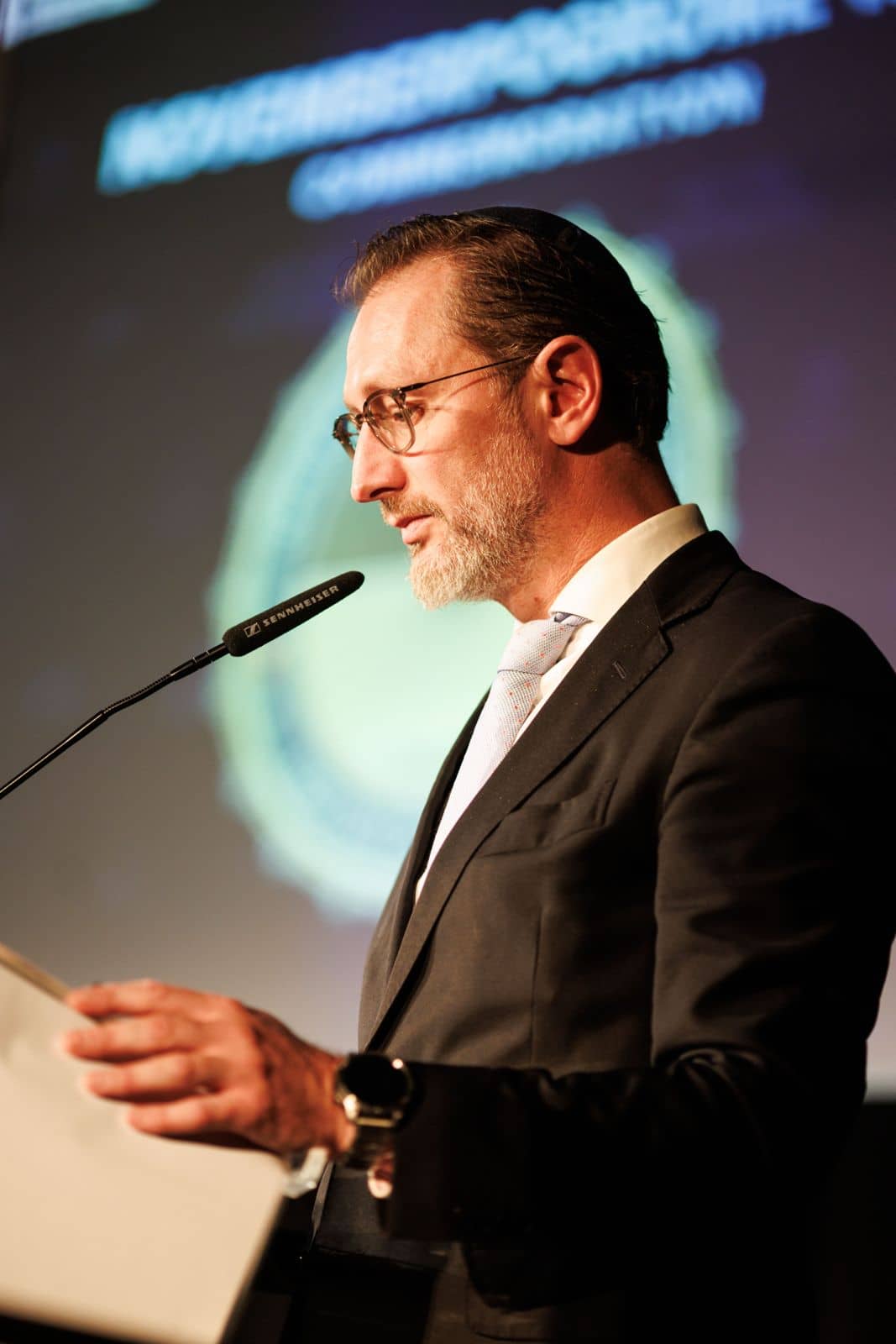
On November 5, 2026, the International March of the Living convened senior police and law enforcement leaders from Germany, other European countries and the United States at the New Synagogue in Berlin – Centrum Judaicum to mark the 88th anniversary of the November 1938 pogroms. The commemoration, “Not on Our Watch: Operationalizing Never Again,” was held in partnership with Gewerkschaft der Polizei (GdP), EU.Pol, Rutgers University’s Miller Center on Policing and Community Resilience, the University of Virginia Center for Public Safety and Justice and the Jewish Community in Berlin. Participants affirmed their responsibility to confront antisemitism and protect Jewish communities.
Pasha Lyubarsky, Chairman of the Kahal Adass Jisroel Orthodox Jewish community in Berlin, shared a personal testimony as the father of two sons who are afraid to walk to synagogue in Berlin because they are visibly Jewish. His full remarks follow.
“No, Dad, wait. I don’t want to go alone.”
I hear these words from my children almost every Shabbat.
Stories like this, in your inbox
Survivor testimonies, history, and news from the March of the Living, once a month.
Sign upStories like this, in your inbox
Survivor testimonies, history, and news from the March of the Living, once a month.
I have two sons. Arieh is 15 years old, and Josh will soon be 13.
When we go to synagogue on Shabbat, they are visibly dressed as Jews. Arieh has already celebrated his bar mitzvah and wears a hat. The fringes of his tallit katan are visible. Josh does not yet wear a hat, but his fringes are visible too.
Sometimes I say to them, “Go on ahead, I’ll follow.” Or, “I’ll go ahead, and you follow in a moment.”
And then I hear:
“No, Dad, wait. I don’t want to go alone.”
They do not like to admit it. But when I ask, they say they are afraid.
Afraid of being harassed or insulted on the street.
And this fear is not imaginary.
On several occasions, people have shouted after my children on the streets of Berlin:
“Are you Jewish? Are you proud of it?!”
Or:
“Free Palestine! Free Hamas!”
Shouted at my sons on their way to synagogue.
My sons were born in Germany. They grew up here. They have nothing to do with political decisions in the Middle East.
And yet they are afraid to walk through the streets of Berlin.
That, ladies and gentlemen, is the reality for Jewish children in Berlin in 2026.
I stand before you today as Chairman of the Jewish community Kahal Adass Jisroel. But above all, I stand here as a father who is worried about his children’s future.
And I would like to tell you another story.
On October 18, 2023, a little over three years ago, two masked individuals attacked our synagogue on Brunnenstraße with Molotov cocktails.
In the middle of the night, at around 4:00 a.m.
A cowardly arson attack on our Jewish community, on a building that houses not only the synagogue but also a Jewish school and a kindergarten.
Fortunately, no one was injured. The incendiary devices did not hit the building. A police officer assigned to guard the premises was able to extinguish the fire quickly.
But what had happened in the hours before?
On October 17, 2023, news spread around the world that Israel had bombed a hospital in Gaza and killed hundreds of people.
There had indeed been a tragic explosion on the grounds of Al-Ahli Hospital.
But the initial reports that Israel had bombed and destroyed the hospital proved to be false. The explosion occurred outside the hospital building. Later investigations pointed to a misfired Islamic Jihad rocket from Gaza.
But by then, the news had already spread around the world.
There were protests and riots in Berlin too.
And just a few hours later, Molotov cocktails were thrown at our synagogue.
Is there a connection between these events?
To me, the connection is obvious.
I see a pattern here that has repeated itself again and again since October 7, 2023:
Something happens in the Middle East, emotions run high, and suddenly Jews in Germany become targets.
But what does our synagogue in Berlin have to do with an explosion in Gaza?
What do my children have to do with the war in the Middle East?
Why must Jews in Germany be held responsible for events over which they have no influence whatsoever?
Ladies and gentlemen,
Representatives of the police from Berlin, from Germany, and from other countries are here today.
That is why I would now like to address you in particular.
I see two essential tasks if we want to combat antisemitism in the long term.
The first is prevention.
We must work with children and young people. We must go into schools and train teachers so they can recognize antisemitism and stand up to it.
Criticism of an Israeli government is, of course, legitimate.
But Jewish children in Berlin must not be held responsible for that government’s policies.
And let me say this very clearly here as well:
Anyone who denies the Jewish people the right to self-determination does not simply have a problem with Israeli politics. They have a problem with Jews.
Anti-Zionism is antisemitism.
This must also be clearly stated in civic education.
But prevention alone is not enough.
The second aspect is the consistent enforcement of the rule of law.
Zero tolerance for violence.
Zero tolerance for hatred of others.
Zero tolerance for antisemitic incitement,
whether it is directed openly against Jews or spread under the pretext of criticizing Israel.
Where crimes are committed, the state must act decisively. Not at some point in the future, but in time.
Because when people are threatened or intimidated on our streets and the state fails to respond adequately, they lose trust in it.
And for a small minority like ours, that trust is vital to our very existence.
Dear representatives of the police,
You represent the authority of the state. You bear an enormous responsibility, because the state has a duty to protect its citizens.
I would like to express my sincere thanks to the police officers who protect our community, our synagogues, and our schools every day.
I know how demanding this work is, and I know that today we could not manage without this protection.
But I would like to ask you for something more.
Help us reach a day when we no longer need this protection.
When Jewish children can walk through Berlin without fear.
When we can visit our synagogues without first having to pass through security checks.
When Jewish life is once again a natural part of public life and does not have to take place behind police barriers.
Surely our goal cannot be to grow accustomed to living under constant police protection.
I said this at a vigil against antisemitism, and I would like to repeat it today:
I do not want to be loved as a Jew. I want to be respected as a human being.
And I want my children to be respected and to enjoy the same freedoms as all other children in Germany.
Ladies and gentlemen,
In closing, I would like to return once more to my two sons.
Arieh and Josh want to become doctors one day. They want to help people.
Despite everything they experience on the streets of Berlin.
And I have a very simple wish.
That one day they will be able to walk through this city as Jews, visibly Jewish, wearing hats and fringes, and no longer have to call out:
“Dad, wait. I don’t want to go alone.”
Help us make this wish a reality.
Thank you very much
Not On Our Watch · Berlin 2026
More from the Kristallnacht 1938 Commemoration
More stories you may find interesting