Alumni Book Club · A Past Selection
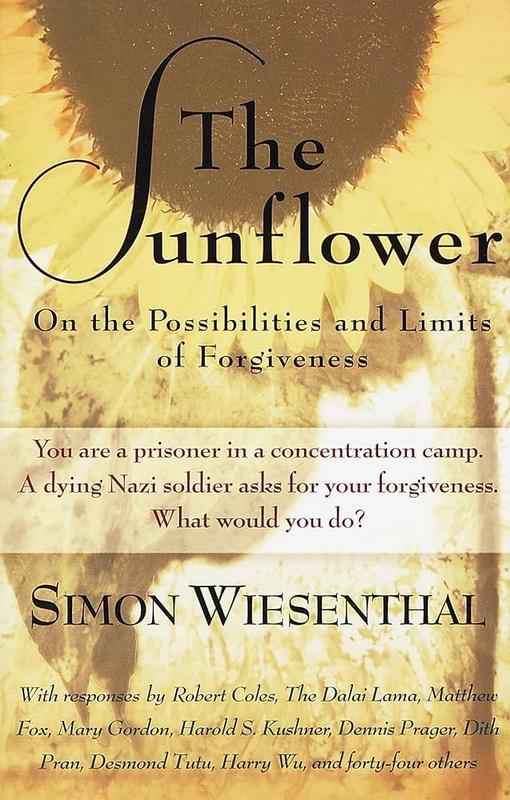
The Sunflower
On the Possibilities and Limits of Forgiveness — by Simon Wiesenthal
We remember together. Now we read together.
A dying Nazi soldier asks a prisoner for forgiveness. What would you do?
Stories like this, in your inbox
Survivor testimonies, history, and news from the March of the Living, once a month.
Sign upStories like this, in your inbox
Survivor testimonies, history, and news from the March of the Living, once a month.
While imprisoned in a concentration camp, Simon Wiesenthal was pulled from a work detail and brought to a hospital room. A dying SS soldier wanted to confess what he had done to a Jewish prisoner — any Jewish prisoner — and to be forgiven for it. Wiesenthal listened. Then he stood up and left the room without a word.
He spent the rest of his life asking whether that silence was right. Decades later he put the question to others: What would you have done? The second half of the book is their answer — a symposium of theologians, writers, jurists, and fellow survivors, including the Dalai Lama, Harold S. Kushner, Desmond Tutu, Dith Pran, and Harry Wu. They do not agree with each other. That disagreement is the point.
Why we chose it
Wiesenthal survived the Holocaust and spent the decades that followed pursuing accountability for it. He is not a neutral narrator of this question, and the book does not pretend otherwise. What it offers instead is a structure our alumni already know well: a story that will not resolve into a lesson, held open long enough for a group of people to sit inside it together.
It is a short book. It is not an easy one. Come with your answer, and be ready to have it moved.
Some of what we will discuss
- Can forgiveness be granted on behalf of people who are no longer alive to grant it?
- Is Wiesenthal’s silence a refusal, a mercy, or something else entirely?
- What is the difference between forgiving, excusing, and forgetting?
- Where do the responses in the symposium land for you — and why that one?
The discussion
Sunday
November 1, 2026
Led by Eli Rubenstein · Director of Education, International March of the Living
Alumni and friends joined from across the world to discuss the book together. Eli’s full notes from the session are below.
Our next selection is Man’s Search for Meaning by Viktor E. Frankl, on Sunday, January 31, 2027. See all selections · Questions? bookclub@motl.org
Alumni Book Club
Every selection, in one place
See what we are reading now, revisit what we have read together, and sign up to hear about each new title as it is announced.
See All SelectionsMarch forward. Remember together. Choose hope.
Alumni Book Club · Session Notes
The Sunflower: On the Possibilities and Limits of Forgiveness
Introduction
Good afternoon everyone, and thank you for joining us for today’s International March of the Living book discussion. The title of our book, of course, is The Sunflower: On the Possibilities and Limits of Forgiveness, by famed Holocaust survivor and Nazi hunter Simon Wiesenthal.
First, some general thoughts about Wiesenthal, though I’m sure most of you are familiar with his biography. But perhaps I can share a few things you did not know. Just before I do that, in the briefest possible terms, here is a summary of the book:
The story, in brief
The year is around 1943. While a prisoner in the Janowska concentration camp near Lviv, Wiesenthal was taken from work detail by a nurse to the bedside of a dying SS soldier, Karl S. The soldier was seeking “a Jew’s” forgiveness for a crime he committed a year earlier: Burning down a house full of about 300 Jews and shooting those who tried to jump from the flames. Among the victims he remembers are a mother and father and the young son they tried to protect. Wiesenthal reluctantly listened to the soldier’s painful confession and then left the room without replying to his request — neither granting nor denying him the forgiveness he requested. The next day the soldier died.
After the war, Wiesenthal tracked down Karl’s mother in Stuttgart and listened to her describe her son’s upbringing. She said her son was a good boy — the local priest viewed him as his favourite — until he joined the Hitler Youth.
Wiesenthal did not tell her what her son had done.
Long after the war, Simon Wiesenthal remained troubled by the question of what he should have done — and whether he did the right thing in not replying, one way or the other, to the dying soldier’s request.
The first part of the book ends with a question: “What would you have done?” The next part of the book includes answers from famous religious personalities, thinkers, philosophers, and other notable individuals to this question.
Now, a few comments about Wiesenthal before we begin our discussion:
Simon Wiesenthal was a colourful character, larger than life. According to historians, not all of his stories and testimonies are 100% accurate; in fact, many of them contradict each other. This does not negate the significance of his lifetime’s work, dedicated to chasing down Nazi war criminals. But it does mean that not everything he says should be taken as 100% accurate.
For me, the most glaring example of this is the claim that there were 11 million victims of the Holocaust (I’m talking civilian victims): 6 million Jews and 5 million non-Jews. This is taken as a truism by many, and was even quoted by Jimmy Carter when he opened the United States Holocaust Memorial Museum. However, the origin of the statistic is unfortunate. When Wiesenthal was trying to gain world attention for the 6 million Jewish victims of the Holocaust, he felt he must mention the plight of non-Jews as well. He did not know the exact number of non-Jewish victims, so he estimated a number that was close to 6 million but less, and chose 5 million.
In fact, many historians would argue that the number of non-Jewish civilian victims was far more than 5 million. This includes non-Jewish Poles, Russians, Ukrainians, Belarusians, Roma, Sinti, disabled people, gay people, etc. Roughly 10 million to 15 million non-Jewish civilians were killed by Nazi Germany and its policies in Europe, which would bring the total number of civilian deaths – Jews and non-Jews – to between 16 and 21 million victims. But these are just estimates. Of course, these numbers do not include Soviet POWs, partisans and Allied forces who fought to liberate Europe from Nazi tyranny.
Before we start our discussion, I would also like to share two lesser-known stories.
In the first story, Wiesenthal found himself in a DP camp after the war, when a fellow Jewish survivor came up to him and asked to borrow five dollars, promising to pay him back within a few weeks. Months passed and the fellow just avoided him. One day he came up to Wiesenthal and said, “I’m going to Canada tomorrow and I would like to pay you back the five dollars.” Wiesenthal refused, explaining that he would rather the man keep the five dollars than forgive him for not paying on time. It’s an interesting story that reminds us how often human beings would rather hold onto resentment than reconcile and grasp the hand reaching out for reconciliation.
The second story takes place in a camp that had just been liberated. The Jewish prisoners got hold of a Nazi posing as a Jewish survivor and immediately pounced on him to take revenge for their murdered family members. They would have killed him had an American soldier not intervened, grabbed the Nazi masquerading as a prisoner, and taken him off to prison. Wiesenthal later reflected that while he was cheering on his fellow prisoners for attacking the Nazi, he was also relieved that the American soldier rescued him, because he realized the law of the jungle no longer applied and they were back inside the protections of civilization and its norms and rules. As much as he hated the Nazi, he was even more terrified of the previous system, where the rule of law had no sway and the law of the jungle applied.
The Discussion
Let’s go on to the book. I have marked several passages that I found very compelling, from both sides of the spectrum. In the responses you will find support for the following positions:
- Complete forgiveness
- Silence
- Absolute unforgiveness
- Variations of number three, including insisting that Karl join the Jewish prisoners in the camp and experience their fate. Or the most extreme example: the writer Mark Goulden says he would leave the room, ensuring there was one less Nazi left in the world. In other words, he would have executed him himself.
As you read the book, you will see a tension between two values that exist within Judaism and other religions as well: the value of justice and the value of compassion. Those looking for complete justice are less likely to forgive. Those looking for complete compassion are more likely to forgive.
There are over 50 respondents in the expanded edition. In our discussion, I would like members of our group to share the passages they found most interesting, challenging, or resonant. I will also share a few passages I found very powerful, even though they are on opposite ends of the spectrum. That’s how difficult this discussion is.
The Dalai Lama says Wiesenthal’s silence was understandable, but that forgiveness is a matter of compassion. He distinguishes between forgiving the person and condemning the act. He tells the story of a Tibetan monk who was imprisoned for 12 years by the Chinese and tortured throughout his imprisonment. The Dalai Lama asked him what he was most afraid of during his imprisonment. His response: “I was most afraid I would lose my compassion for my Chinese persecutors.”
Is this response a noble example of compassion and kindness? Or is it misplaced mercy for someone who does not deserve it? You can see how easy it is for some to take either side in this debate.
Robert McAfee Brown states that at first glance there are two imperatives: to never forget and to never forgive. Never forgetting is quite understandable. But should we never forgive? He answers that in this case, perhaps not; otherwise you are giving a sign to the future that what happened was OK. You are giving them a moral escape valve. To forgive is to become one with the Nazis. Other writers in this volume compare forgiving the Nazi soldier to “cheap grace,” which is not the same as true and deeply felt repentance.
On the other hand, McAfee Brown gives the example of Tomas Borge, a founder of the Sandinista movement in Nicaragua. He was imprisoned and tortured under the Somoza regime, and when the revolution succeeded and his torturers were put on trial, the judge asked Borge what punishment he wanted for his persecutors. His answer: “My punishment is to forgive you.” In other words, you have to live with the terrible things you did to me, even if you understand that I have forgiven you.
Harry James Cargas “I am afraid not to forgive, since I may not be forgiven.” Mercy and justice must stand side by side.
Catholics in Spain prayed for the soul of Adolf Hitler after he died. Was this an act of antisemitism, or an act of piety and charity?
Christian scripture refers to an unforgivable sin. There are many interpretations of what that sin might be, but the principle is there that some sins are simply not worthy of forgiveness.
Eugene Fisher Jews who do not forgive the soldier are dismissed by some as unforgiving and vengeful. Is that not the same antisemitism that caused the Holocaust?
Edward Flannery Where would be the harm in forgiving him? If Karl died in this happy illusion? “I would have forgiven him and prayed for his soul.”
Eva Fleischner Christian and Jewish students in her class had opposing views. Generally, the Jewish students were less likely to forgive, while the Christian students were more likely to be forgiving in this instance.
Matthew Fox Listening and being silent to both the mother and the soldier was an act of compassion, as was holding his hand.
Here I would like to reference a quote from Simone Weil, who said that listening is the greatest act of compassion you can do for someone else.
Rebecca Goldstein argues that Wiesenthal did not stereotype this young Nazi (“they’re all bad, they’re all really terrible”) but looked at him as an individual, actually considering that he might be genuinely penitent. But she also says the young Nazi soldier had no right to ask for forgiveness, only to express remorse.
Mary Gordon argues that, as active penance, the soldier should have asked to be taken from his bed and put into the camp of the Jews. That would have been the only way he could have earned forgiveness.
Mark Goulden gives the most extreme response. He says he would have left the room, making sure there was one less Nazi left in the world, given what he felt about this person.
Abraham Joshua Heschel , like many others featured in the book, holds that no one can forgive on behalf of the murdered. He sees Wiesenthal’s silence as an appropriate response. And he relates a very famous story:
“Over fifty years ago, the rabbi of Brisk, a scholar of extraordinary renown, revered also for his gentleness of character, entered a train in Warsaw to return to his hometown. The rabbi, a man of slight stature, and of no distinction of appearance, found a seat in a compartment.
There he was surrounded by traveling salesmen, who, as soon as the train began to move, started to play cards. As the game progressed, the excitement increased. The rabbi remained aloof and absorbed in meditation. Such aloofness was annoying to the rest of the people and one of them suggested to the rabbi to join in the game. The rabbi answered that he never played cards. As time passed, the rabbi’s aloofness became even more annoying and one of those present said to him: “Either you join us, or leave the compartment.” Shortly thereafter, he took the rabbi by his collar and pushed him out of the compartment. For several hours the rabbi had to stand on his feet until he reached his destination, the city of Brisk.
Brisk was also the destination of the salesman. The rabbi left the train where he was immediately surrounded by admirers welcoming him and shaking his hands. “Who is this man?” asked the salesman. “You don’t know him? He is the famous rabbi of Brisk! The salesman’s heart sank. He had not realized who he had offended. He quickly went over to the rabbi to ask forgiveness. The rabbi declined to forgive him. In his hotel room the salesman could find no peace. He went to the rabbi’s house and was admitted to the rabbi’s study. “Rabbi he said, “I am not a rich man. I have, savings of three hundred rubles. I will give them to you for charity if you will forgive me. The rabbi’s answer was brief: NO!
The salesman’s anxiety was unbearable. He went to the synagogue to seek solace. When he shared his anxiety with some people in the synagogue, they were deeply surprised. How could their rabbi, so gentle a person, be so unforgiving? Their advice was for him to speak to the rabbi’s eldest son and to tell him of the surprising attitude taken by his father.
When the rabbi’s son heard the story, he could not understand his father’s obstinacy. Seeing the anxiety of the man, he promised to discuss the matter with his father.
It is not proper, according to Jewish law, for a son to criticize his father directly. So the son entered his father’s study and began a general discussion of Jewish law, then turning specifically to the laws of forgiveness. When the principle was mentioned that a person who asks for forgiveness three times should be granted forgiveness, the son mentioned the name of the man who was in great anxiety. Thereupon the rabbi of Brisk answered: “I cannot forgive him. He did not know who I was. He offended a common man. Let the salesman go to them and ask for forgiveness.”
In other words, the Rabbi of Brisk was saying: you did not just insult me, you insulted every single poor, simple Jew in this town. So I can’t give you forgiveness; you must ask it of each one of them.
It’s also important to share the classic story of forgiveness in the Torah. In the famous story of Joseph, his brothers kidnap him and plot to murder him but, at the last moment, sell him to slave traders. Joseph ends up in Egypt, eventually rising to the number two position in Pharaoh’s palace after successfully interpreting Pharaoh’s dreams and forecasting a time of plenty followed by a time of famine.
Many years later, during the famine in the land of Canaan, the only place in the region with food is Egypt, because Joseph correctly interpreted Pharaoh’s dream and was able to predict the coming famine.
Joseph’s brothers arrive in Egypt, begging for food. Joseph insists they return with their youngest brother Benjamin, holding Simeon captive until they do so. They return with Benjamin, and this time Joseph frames Benjamin by placing a goblet in his possession, but allows the remaining brothers to go back to Canaan.
So this is the pivotal moment. The brothers have a choice. They can repeat the mistake of their past by sacrificing their youngest brother and once again causing their father unending grief. Or they can change their ways, refuse to do so, and forge a new path.
This is the most critical moment in all of biblical literature. At that moment Judah steps forward and says no, you may not keep Benjamin, for our father will not survive this tragedy. He has already lost his other favourite son in a similar manner. “Take me instead!” he pleads with Joseph.
And that’s when Joseph breaks down and says: “I am Joseph, your brother. Is my father still alive?”
That is the most beautiful moment in all of biblical literature, where love overcomes hate and forgiveness overcomes the desire for revenge. The brothers find themselves in exactly the same situation they were in years earlier, but this time they acknowledge their sin and choose to take a different path. And that is why Joseph forgives them.
Teiku
As we come to the end of our discussion, it is worth reflecting on the Talmudic concept of TEIKU (תיקו). In modern Hebrew, teiku is also the word for a tie at the end of a soccer game.
The Talmud uses this word when a question or dispute defies easy resolution. The sages could not decide between the opposing arguments, so the question is left open.
The traditional explanation maintains that TEIKU is an acronym for Tishbi Yetaretz Kushyot u’Ba’ayot, “the Tishbite (Elijah) will resolve difficulties and questions.” In other words, when the prophet Elijah appears, he will settle all open issues during the messianic era.
For the purposes of our discussion, we must acknowledge the limits of human wisdom and judgment, and understand that there are certain questions — like this one — that will perhaps remain forever open.
Concluding Remarks
Allow me to conclude with four observations or stories.
- There is a deep irony here. I would guess that 99% of Nazi war criminals went to their deaths without ever being brought to trial, never mind convicted. Most of them died in their sleep and, as far as we can tell, without any compunction for what they did. And yet here we have Simon Wiesenthal, who lost, I believe, 89 members of his family during the Holocaust, and who decades later is still troubled in his conscience by the thought that he did not perhaps do right by this dying young Nazi soldier. What a contrast in ideologies! One ideology, a murderous one, completely disavows penance until the last moment (this young Nazi soldier is the exception). The second ideology is still wondering whether it should have forgiven someone who subscribed to the first, despite the terrible atrocities he had committed.
- Many years ago I met a Holocaust survivor named Mike Kanitz, in Saskatoon, who told me a story that reflects the dilemma we are having here. He, his mother and his brother were hidden by a Hungarian woman in Budapest in 1944 and 1945. The woman was kind and compassionate, but unfortunately her son was not. He was a member of the Arrow Cross, and she warned Mike, his mother and his brother that whenever her son came home they must stay out of sight, because he would certainly report and betray them, and they would be executed.
When the war was over, Mike’s father survived and came back, and became a leading political figure in Budapest, in charge of prosecuting Nazi criminals and Hungarian collaborators. As it turned out, the woman’s son was captured, and Mike’s father was in charge of his punishment, which turned out to be a death sentence. Before the sentence was carried out, the mother, who had no husband and only this one son, came to the family begging that her son’s life be spared. He was all she had left, and, considering what she had done for the family, could they not spare his life as an act of compassion?
After the woman left, Mike’s mother turned to her husband and said, “Of course you must save him. Look what his mother did for your family! We would not be here without her.” The father replied, “I know what the mother did for you, for me and for our children, but that does not excuse all of the murders this young man was involved in. What about the rights of those victims and their families? What do you think they would say?” A week later the son was executed, and his mother lived out the rest of her days broken hearted.
I asked Mike who he thought was right, his father or his mother. He replied, “When I was a young man, I thought my mother was right and my father should have spared his life. But the older I get and the more I see of the world, the more I think my father was right and that his life should not have been spared.” So this moral dilemma, similar to the one we are discussing, can even produce different opinions in the same person depending on what stage of life he is at.
- One last anecdote. Standing in a cemetery in Kielce, Nate Leipciger, who is now 98 years old and has been on 22 Marches of the Living, was asked by a student on the 1998 March whether he hated the soldiers who did the terrible things to the Jews of Kielce. Here is the dialogue that took place:
Nate Leipciger“You cannot have hate in your heart without being hateful against yourself. And that’s the big problem: when you are hateful, you become bitter, you resent everything, and that becomes part of your nature.”
Student“You don’t hate the soldiers who took those kids out and murdered them?”
Nate Leipciger“There is a difference between hating and holding them responsible. They are two different feelings. I don’t have to like them, but I don’t hate them. Because hate will destroy the person doing the hating.”
- Let me conclude with one last thought. There are two questions I’ve been asked over my years in Holocaust education. The first is: how could humanity sink so low, to such levels of barbarism? Like the story we heard of 300 or so Jews being burnt alive in a house, including many children. How would you ever understand that? I’m afraid I’ll never have an answer to that question.
But there is a second question, which is perhaps even more important, and which I do have an answer to: how do we respond to the history and events of the Holocaust? The answer is this. Hitler tried to create a world of endless hatred, division, anger and animosity. The way we best honour the memory of Holocaust survivors must be the opposite: to create a world of endless love, kindness and compassion. The answer to hate is not more hate, and the answer to darkness is not more darkness. The answer is more love and more light.
Let me close with a poem by one of our students, Jennifer Staffenberg, who wrote it after the 1994 March of the Living.
Still I Cannot Hate
I see bones and hair, shoes and glasses.
While in a Nazi hell ruled by the devil’s brother,
But still I cannot hate.
I see women’s brushes, men’s talisim and babies’ tattered clothing,
But still I cannot hate.
I see splintered boards where people laid their weary bodies,
I see where people slaved and tried to exist,
And still I cannot hate.
I see the death and destruction,
But still I cannot hate.
I won’t continue this tragedy, I won’t spread the disease.
I won’t fan the flames, that hate like this inspires.
Jennifer Staffenberg, age 17, Vancouver, BC
The Alumni Book Club meets online and is open to everyone — you do not need to have marched to join us. Our next selection is Man’s Search for Meaning by Viktor E. Frankl, on Sunday, January 31. Details and every past selection: motl.org/bookclub