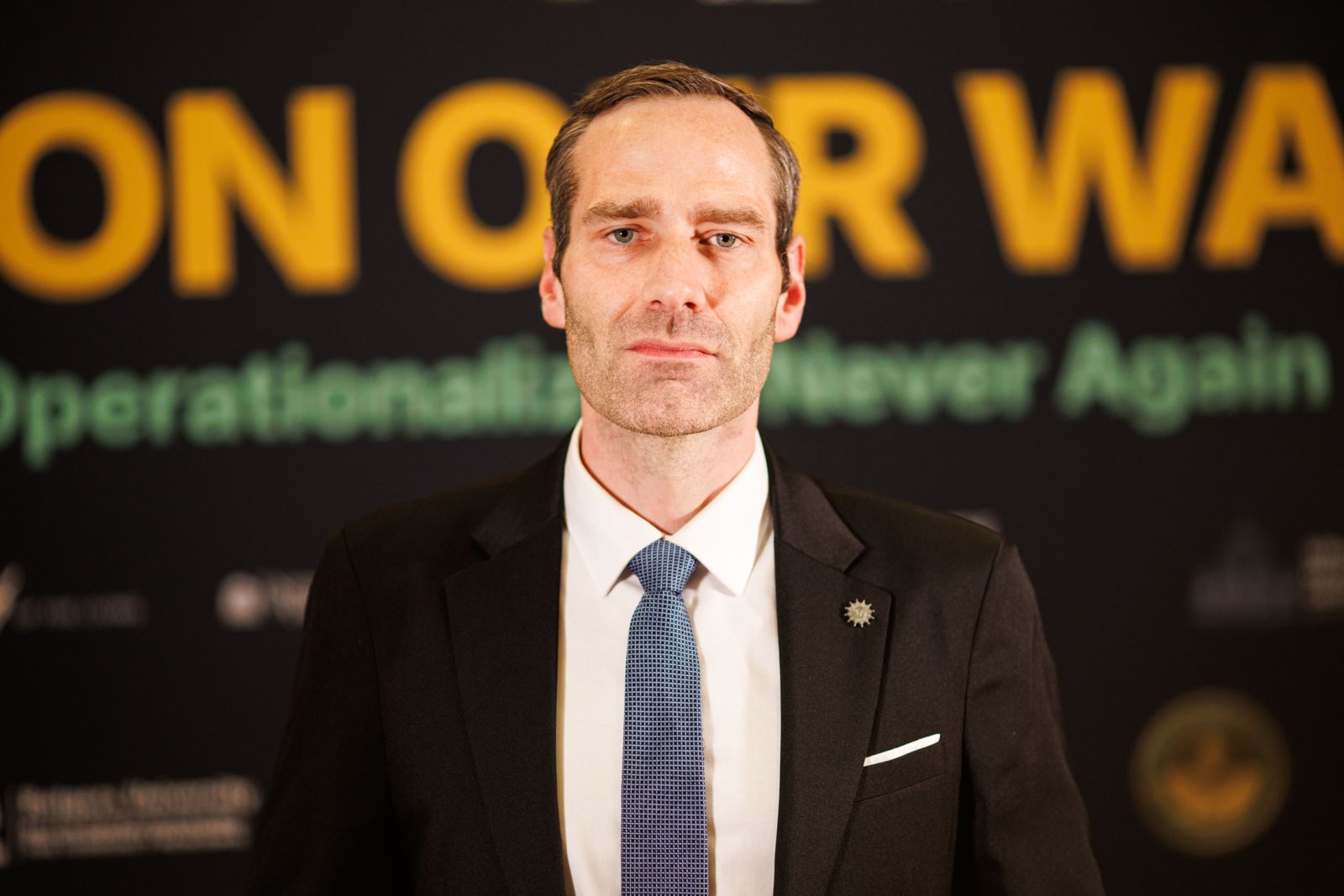
On November 5, 2026, the International March of the Living convened senior police and law enforcement leaders from Germany, other European countries and the United States at the New Synagogue in Berlin – Centrum Judaicum to mark the 88th anniversary of the November 1938 pogroms. The commemoration, “Not on Our Watch: Operationalizing Never Again,” was held in partnership with Gewerkschaft der Polizei (GdP), EU.Pol, Rutgers University’s Miller Center on Policing and Community Resilience, the University of Virginia Center for Public Safety and Justice and the Jewish Community in Berlin. Participants affirmed their responsibility to confront antisemitism and protect Jewish communities.
The Berlin event was led by Jochen Kopelke, Federal Chairman of the GdP and President of EU.Pol, who took part in this year’s March of the Living and lit a torch dedicated to combating antisemitism alongside international colleagues. His full remarks follow.
It warms my heart to be able to share this historically significant space with so many people who have devoted themselves wholly and exclusively to humanity. I say this also in memory of the extraordinary, admirable Margot Friedländer. To her, it did not matter how important someone’s work was; what mattered was simply that they were a decent human being.
In view of the alarming increase in antisemitic acts in the Federal Republic, I feel obliged to use every means at my disposal to confront the terrible, deeply concerning and clearly discernible rise of German, homegrown antisemitism. As a citizen, as a democrat, as a trade unionist, as a police officer and, above all, as a human being.
Stories like this, in your inbox
Survivor testimonies, history, and news from the March of the Living, once a month.
Sign upStories like this, in your inbox
Survivor testimonies, history, and news from the March of the Living, once a month.
In these capacities, I am part of our state, the Federal Republic of Germany, which continues to bear the enduring duty to remember the brutal annihilation of Jews under Nazi rule during the Third Reich. Yet remembrance must also nurture humanity across every generation in our country.
Our country has incurred enormous guilt. It cannot absolve itself, now or ever. The clear and perpetual duty must remain: to remember the almost incomprehensible atrocities of the Holocaust, never to forget the victims of the Nazi regime of terror, and forever to block the path the Nazis took to murder Jews on an almost industrial scale. That is our responsibility.
Anyone who has engaged even a little with the unspeakable suffering of Jews under the Nazi dictatorship could never consider drawing a line under Holocaust remembrance. What kind of individuals and groups have, for some time now, been openly, increasingly aggressively and increasingly publicly demanding that Germany’s dark chapter be closed, that the book be shut? We fail to grasp these zealots from radical and extremist circles if we describe them merely as people stuck in the past. That misses the point. Because they want to determine tomorrow. And that is extremely dangerous.
It is unsurprising that prominent voices within Alternative for Germany belong to those advocating such a line, given the remarks of party co-leader Alice Weidel. In a report broadcast by NDR’s Panorama programme in February this year, she spoke of a German “cult of guilt” that had become entrenched around remembrance of the Holocaust and the Nazi past. In the same report, Hans-Thomas Tillschneider, then deputy chairman of the AfD parliamentary group in Saxony-Anhalt and now vice-president of its state parliament, acknowledged that historical injustice must not be forgotten, but said that it must no longer burden “us today.”
A cult generally involves an object of worship, a group of people who practise it, and fixed rituals performed at particular places or times. This characterisation of Germany’s historical guilt, its reduction to a “cult of guilt,” mocks the victims of the Nazi killing machine. It is nothing less than that. And the claim that Germany’s historical guilt should no longer burden us reveals, in an intolerable way, the AfD’s portrayal of the Holocaust as an evil of its time whose weight, they suggest, continues unjustly to rest on our shoulders. Anyone who promotes such an understanding of history and rejects the responsibility borne by the state as a consequence of the Holocaust is an enemy of democracy and of humanity.
Another example, which leaves observers speechless, shows just how strongly this crude rhetoric resonates: at the end of September, a majority comprising the CDU, the AfD and the Heidenau Citizens’ Alliance on the Saxon town’s council voted to stop the installation of further so-called Stolpersteine, or “stumbling stones.” Everyone in this room understands the importance of these memorial stones. Each of you, like me, will have encountered them on your way to this commemorative event. Every stone represents a moving, cautionary story of expulsion and murder.
Speaking of Heidenau: just over ten years ago, a town councillor from the far-right NPD, now called “Die Heimat,” called for protests against a hastily prepared refugee shelter. The result: around 1,000 people marched through Heidenau, among them recognisable neo-Nazis, but also families with children. Outside the makeshift refugee shelter, a vacant DIY store, the crowd was stirred up. Stones and bottles were thrown, and fireworks were set off and used against the police. By the end, 31 officers had been injured. The riots continued for two days. The then Federal Chancellor, Angela Merkel, who travelled to Heidenau shortly afterwards, was branded a “traitor to the people” there.
The instigators behind all of this can now claim a result: hatred was sown, and its poisoned fruits are ready to be harvested. I am deeply concerned that the disastrous signal once again sent from Saxon Switzerland will be taken up by others in our country. It is up to us, the democrats of this country, to prevent that harvest and prepare the ground for fresh, strong democratic growth.
I therefore support, with every fibre of my being, the International March of the Living’s sharp criticism of Heidenau town council’s decision on the Stolpersteine. I consider it profoundly reprehensible and utterly absurd to appropriate the important symbol of these memorial stones for political interests whose intentions reflect the opposite of humanity. Thank you to the initiative for its clear words.
The horrific terrorist attacks of October 7 have massively intensified incitement and hatred directed at our Jewish fellow citizens, at Jews more broadly, and at the State of Israel. Inevitably, this shocking development has affected, and continues to affect, the work of German police officers.
One thing, however, is crystal clear: police personnel protect Jewish life in Germany and consistently pursue attacks committed by antisemites. Hatred and incitement, vilification, threats, violent attacks and acts of terrorism must be given no space in our society, regardless of whom they target, whether online or offline.
As a major organisation representing police employees in the Federal Republic, we have acted decisively and swiftly. Everywhere, we make clear what the police need to fulfil their part in the fight against hatred of humanity and hatred of Jews. And, unfortunately, those needs are considerable.
As police, we need greater political support. We need sufficient personnel and adequate funding. We need up-to-date equipment, including for our own protection. We need research, specialist knowledge and effective prevention strategies. We need closely connected digital systems. We need good laws and powers that work in practice. We need a modern federal system that harmonises police work. We want to be a strong executive authority, with a strong judiciary as our partner in a robust chain of law enforcement and justice. But without political leaders as close allies, we cannot make progress.
There is work to be done within the police as well. We are committed to ensuring that the police further strengthen and consolidate their resilience against anti-democratic activities. As a trade union, we advocate greater awareness within the police of Jewish life in all its facets. This is one of the reasons we are pleased to maintain partnerships with Jewish institutions and political organisations, enabling us to expand our educational provision professionally and in a targeted way.
Yet it is bewildering that, despite the extremely tense situation, we must wait for political action before we can carry out our policing mandate more effectively. As recently as September, Federal Chancellor Merz himself stated that Jewish life in Germany was no longer safe. Sadly, that is true. Nevertheless, does he thereby accept responsibility for this? He leaves unanswered how, and to what extent, the government intends to provide support, for example to the police. His statement may be important in these times, but one must ask whether party-political interests also took precedence in this case.
Finally, a few personal words: having taken part in a March of the Living in Auschwitz makes a profound difference. The opportunity to speak with survivors of that brutal wave of extermination touches you deeply and changes you. Horror and grief quickly turn into an absolute motivation and determination never to allow anything even remotely similar to happen again. This conviction is reinforced by the clear stance of young people, who also experience Auschwitz in their own, deeply individual ways, yet agree on one fundamental principle: never again.
I am now pleased to introduce the next part of our joint event here in the restored rooms of Berlin’s Neue Synagogue on Oranienburger Straße, at Centrum Judaicum.
The story we are about to hear took place right here.
On the night of the November pogroms in 1938, as synagogues burned throughout Germany, police officer Wilhelm Krützfeld and his colleagues intervened to protect this synagogue and prevent even greater destruction by fire.
His story is told in Heinz Knobloch’s book Der beherzte Reviervorsteher [The Courageous Police Station Chief]. It reminds us that the decisions of a single police officer can make a profound difference, and that wearing a uniform carries the responsibility to protect human life and the dignity of every individual.
This responsibility lies at the heart of “Not On Our Watch,” an initiative for democratic policing.
Not On Our Watch · Berlin 2026
More from the Kristallnacht 1938 Commemoration
More stories you may find interesting